The AfriCHI 2027 Mentorship Programme is a community-driven initiative designed to connect students, early-career researchers, and emerging HCI practitioners with experienced members of the African and international HCI community.
As we come together for AfriCHI 2027 in Lagos, Nigeria, the mentorship programme will create opportunities to exchange ideas, develop research and professional skills, build meaningful connections, and support emerging researchers in shaping their own journeys within HCI.
Guided by the AfriCHI 2027 theme, “People, Place, and Possibilities: Designing plural African futures with dignity and agency,” the programme recognises that mentorship is not simply about transferring knowledge from experienced researchers to those who are beginning their careers. It is about creating spaces for dialogue, mutual learning, and shared growth.
We seek to foster relationships in which diverse experiences and perspectives are valued, local contexts are respected, and mentees are supported to develop the confidence and agency to shape their own research and professional futures.
Whether you are developing a research project, preparing a paper, navigating the peer-review process, preparing to present your work, exploring academic or industry pathways, or looking to expand your research network, the mentorship programme provides opportunities to connect, learn, and grow.
We welcome experienced researchers and practitioners who are willing to share their knowledge and experience, as well as students and early-career researchers who are eager to learn, contribute, and engage with the community.
If you are interested in taking part as a mentor, please complete the following form here. If you would like to participate as a mentee, kindly complete this form. The deadline for both applications is 19th October, 2026. By completing a minimum of 30 hours for the mentorship programme, your involvement will be recognised and you will be awarded with a digital certificate.
Developing a research career can involve many questions and challenges. Emerging researchers may be navigating research design, academic writing, publishing, peer review, presentations, collaboration, funding, career development, and building professional networks.
Mentorship can provide a supportive environment in which these challenges can be explored through dialogue and shared experience.
At AfriCHI 2027, we see mentorship as a two-way process. Mentors bring knowledge, experience, and perspectives, while mentees bring their own ideas, experiences, contexts, and aspirations. Both contribute to the creation of a richer and more diverse research community.
The programme aims to create opportunities for participants to learn from one another while recognising the importance of context, lived experience, and different pathways into and through HCI.
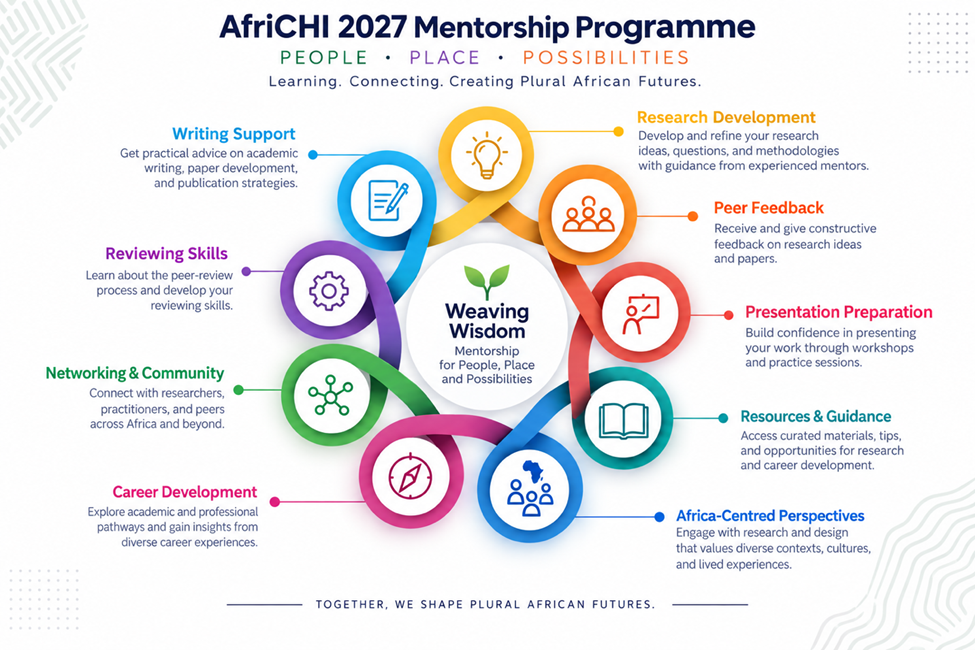
The AfriCHI 2027 Mentorship Programme aims to:
Through the programme, we hope to support emerging researchers not only in participating in AfriCHI, but also in contributing to conversations about the diverse futures that HCI can help imagine and shape across Africa.
The AfriCHI 2027 Mentorship Programme will bring together mentors and mentees through a combination of group activities, interactive sessions, workshops, and opportunities for meaningful engagement.
Activities may include:
Sessions supporting the development of research ideas, research questions, methodologies, contributions, and approaches that are responsive to specific contexts and communities.
Practical guidance on academic writing, developing research papers, responding to feedback, and navigating the publication process.
Interactive sessions introducing participants to peer review and exploring how to give and respond to constructive feedback.
Guidance on communicating research clearly and effectively through oral presentations, posters, demonstrations, and other conference formats.
Discussions exploring how people, places, communities, cultures, and lived experiences can inform HCI research and design.
Conversations about academic and professional pathways, collaboration, networking, research visibility, and developing a sustainable research career.
Opportunities to connect with researchers and practitioners from different countries, institutions, disciplines, and career stages.
Spaces where mentees can share experiences, challenges, ideas, and perspectives and learn from one another.
The programme will emphasise active participation and dialogue. Participants will be encouraged to bring their own questions, experiences, contexts, and aspirations to the conversation.
Make the Most of Your Mentorship Journey
Being part of the mentorship programme is an opportunity to actively invest in your academic and professional development.
We encourage mentees to:
Mentorship provides guidance and opportunities, but mentees remain active participants in shaping their own journey. We encourage every mentee to bring their own voice, perspective, and aspirations to the programme.
Mentors play an important role in creating a supportive and connected AfriCHI community.
We invite experienced researchers, academics, practitioners, and professionals to share their knowledge and experiences with emerging members of the community.
Mentors may contribute in different ways, including:
Effective mentorship is not about providing all the answers. It is about listening, asking questions, sharing experience, encouraging reflection, and creating space for others to develop their own ideas and direction.
Mentors are also learners. The perspectives, experiences, and knowledge of emerging researchers can challenge assumptions, introduce new ideas, and enrich the wider HCI community.
The AfriCHI 2027 mentorship programme is grounded in the idea that HCI futures are shaped by people and the contexts in which they live, work, create, and interact.
We value the experiences, knowledge, aspirations, and voices of individuals and communities. Mentorship should create space for diverse perspectives and encourage participants to develop their own agency.
Research and design do not happen in isolation. African contexts are diverse, and approaches that work in one setting may not necessarily translate directly to another. We encourage attention to local realities, cultures, histories, resources, and lived experiences.
Mentorship can open opportunities to imagine new research questions, collaborations, technologies, career pathways, and approaches to HCI. We encourage participants to explore possibilities beyond established assumptions and to contribute to shaping plural African futures.
We believe that mentorship should support people rather than speak for them. The programme aims to create relationships built on respect, reciprocity, and trust, while encouraging mentees to develop the confidence and agency to make their own decisions and shape their own futures.
AfriCHI brings together people with different backgrounds, experiences, disciplines, institutions, countries, career stages, and perspectives.
Our mentorship programme is committed to creating an environment in which participants feel welcomed, respected, heard, and encouraged to contribute.
We encourage mentors and mentees to approach the programme with curiosity, openness, humility, and respect.
The diversity of African contexts is central to this approach. We encourage conversations that recognise different realities rather than assuming that one research approach, career pathway, or experience applies universally.
Mentorship extends beyond the conference itself.
Participants will have opportunities to prepare for the conference, develop research and presentation skills, clarify their goals, and connect with members of the mentorship community.
Mentors and mentees will have opportunities to meet, participate in dedicated activities, attend sessions together, exchange ideas, and engage with the broader AfriCHI community.
We hope that relationships developed through the programme will continue beyond the conference, creating opportunities for future collaboration, knowledge exchange, and professional connections.
The application and programme dates for AfriCHI 2027 will be announced by the organising committee.
| Milestone | Date |
| Mentee applications open | 5 Oct 2026 |
| Mentee application deadline | 26 Oct 2026 |
| Mentee notifications | 2 Nov 2026 |
| Mentor applications open | 5 Oct 2026 |
| Mentor application deadline | 26 Oct 2026 |
| Mentor notifications | 2 Nov 2026 |
Further Resources
Further information about applications, programme activities, mentorship resources, and key dates will be shared as the AfriCHI 2027 programme develops.
For questions about the mentorship programme, please contact:
AfriCHI 2027 Mentorship Team
Email: mentorship@africhi.africa
Ten simple rules for structuring papers: https://www.ncbi.nlm.nih.gov/pmc/articles/PMC5619685/
Starting the literature review: https://patthomson.net/2020/08/03/how-to-start-on-a-literature-review/
Searching the literature: https://thesiswhisperer.com/2015/05/13/how-to-become-a-literature-searching-ninja/
Reviewers, don’t be rude to nonnative English speakers: https://www.sciencemag.org/careers/2019/10/reviewers-don-t-be-rude-nonnative-english-speakers
How to become good at peer review: A guide for young scientists: https://violentmetaphors.com/2013/12/13/how-to-become-good-at-peer-review-a-guide-for-young-scientists/
Criticality Need Not Be Negative in HCI: https://interactionculture.net/2018/07/30/criticality-need-not-be-negative-in-hci/
2023 Mentorship Resource: https://docs.google.com/document/d/1jhsBla-mCWPX7T3TrHSW5Kw9gJuc605dgeTOcmcX2Nk/edit?usp=sharing